
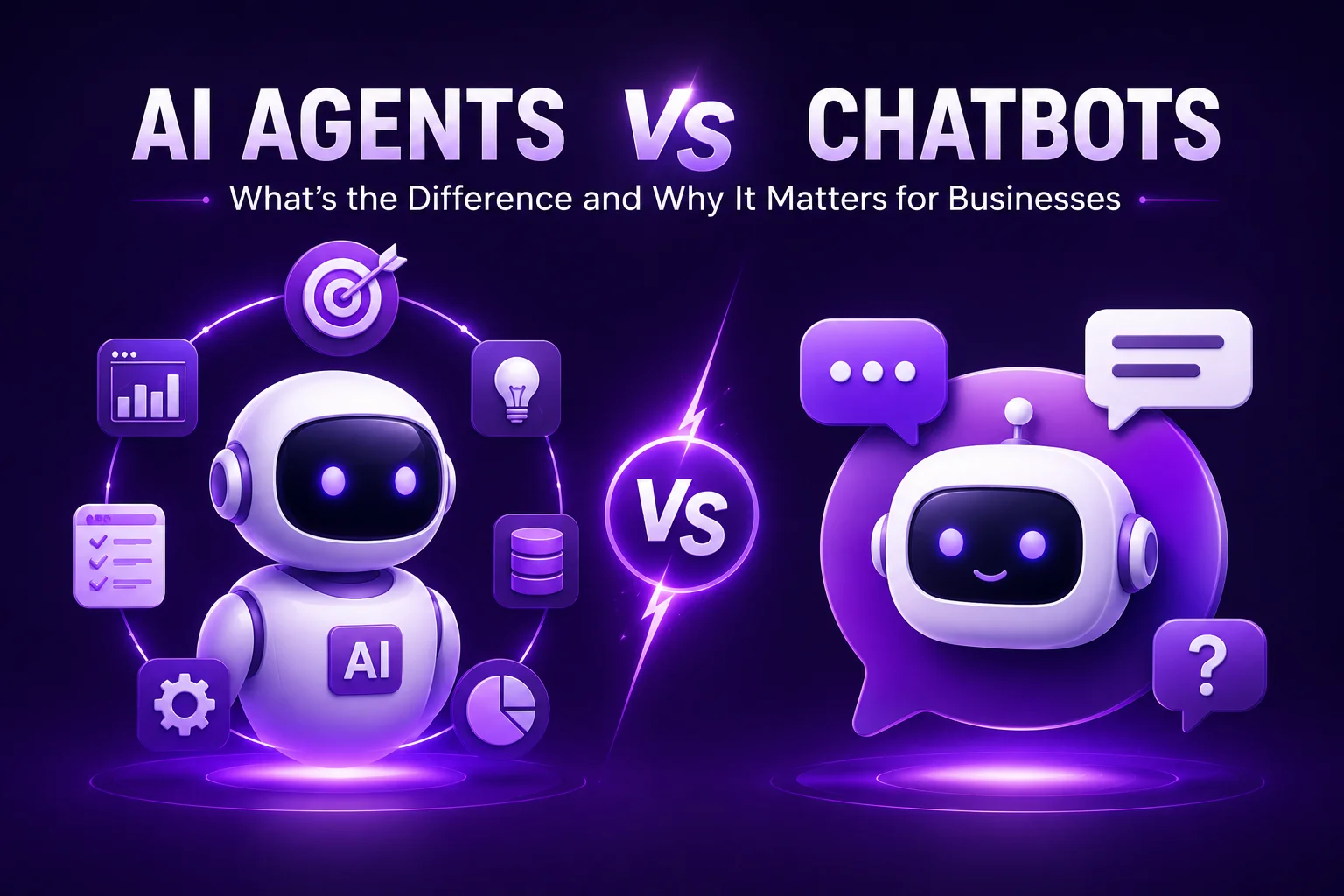
AI Agents vs Chatbots: What’s the Difference and Why It Matters for Businesses
Quick Answer: When comparing AI agents vs chatbots, the core difference comes down to this chatbots follow scripted, rule-based conversation flows and are best for answering simple, repetitive questions, while AI agents use large language models and reasoning to understand intent, make decisions, and complete multi-step tasks like updating an order, qualifying a lead, or triggering a workflow without constant human input. For businesses scaling customer support or operations in 2026, AI agents deliver deeper automation and better ROI than traditional chatbots, though many companies use both together depending on the task.
Business owners across the US and Europe keep asking the same question: should we automate with a chatbot or an AI agent? The terms get used interchangeably in marketing copy, but they are not the same technology, and picking the wrong one can mean wasted budget, frustrated customers, or a support team still doing manual work that should have been automated months ago.
This guide breaks down exactly how AI agents and chatbots differ, when each one makes sense, and how growing businesses from Los Angeles e-commerce brands to Chicago service companies are using intelligent automation to cut response times and free up their teams.
Key Takeaways
- Chatbots follow pre-set decision trees or simple keyword matching; they can’t handle requests outside their script.
- AI agents use reasoning and context to understand what a customer actually wants and take action to resolve it.
- AI agents can connect to your CRM, inventory, calendar, and payment systems chatbots typically can’t.
- Businesses using AI agents for customer support report faster resolution times and lower reliance on live agents for routine queries.
- The right choice depends on your use case, budget, and how complex your customer interactions are not just which tool is trendier.
What Is the Difference Between an AI Agent and a Chatbot?
A traditional AI chatbot operates on predefined rules, decision trees, or basic keyword recognition. Ask it something it wasn’t programmed to expect, and it either loops back to a generic response or hands the conversation to a human. Chatbots are fast to deploy and cheap to run, which is why they’ve been the default for basic FAQ and lead-capture widgets for years.
An AI agent is fundamentally different. Built on large language models (LLMs), AI agents can interpret intent, hold context across a conversation, make decisions, and critically take multi-step actions across connected systems. Instead of just replying with text, an AI agent can look up an order status, reschedule an appointment, escalate a billing dispute with the right context attached, or route a qualified lead directly into your CRM.
Think of a chatbot as a receptionist reading from a script. An AI agent is closer to a trained team member who can actually get things done.
AI Agents vs Chatbots: Side-by-Side Comparison
| Feature | Traditional Chatbot | AI Agent |
|---|---|---|
| How it works | Rule-based / decision tree | LLM-powered reasoning |
| Handles unscripted questions | No | Yes |
| Takes action (bookings, updates, refunds) | Rarely | Yes, via integrations |
| Learns from context across a conversation | Limited or none | Yes |
| Connects to CRM/ERP/inventory | Rarely | Commonly |
| Best for | Simple FAQs, basic lead capture | Support, sales, workflow automation |
| Setup complexity | Low | Moderate (needs proper integration) |
| Long-term ROI for growing businesses | Limited | High |
Why Does This Matter for Business Automation?
Because the tool you choose directly affects two things every business owner cares about: cost per resolved query, and customer experience. A chatbot that can’t resolve a request creates a second point of friction the customer has to repeat themselves to a human agent, which is often worse than not offering self-service at all.
AI agents close that gap. When automation can actually resolve the issue not just acknowledge it you reduce ticket volume, shorten response times, and free your team to handle the complex, high-value conversations that need a human touch. That’s the real promise behind AI workflow automation: not replacing your team, but removing the repetitive 80% of tasks so your people can focus on the 20% that actually needs judgment.
This is also where a lot of businesses get their web presence wrong. An AI agent is only as good as the systems it’s connected to, and a support widget bolted onto a slow, poorly structured website will underperform no matter how smart the underlying model is. Teams working with an experienced web development partner tend to see AI support tools perform noticeably better, simply because the site architecture and data are set up to support real-time automation instead of fighting against it.
How Do AI Agents Handle Customer Support Differently?
AI customer support built on agents typically follows this flow:
- Understand intent the agent parses the actual request, not just keywords.
- Check context pulls relevant account, order, or ticket history automatically.
- Decide the action determines whether it can resolve the issue directly or needs to escalate.
- Execute processes a refund, updates a record, books an appointment, or answers with accurate, personalized information.
- Log and learn the interaction feeds back into your systems for reporting and improvement.
Compare that to a chatbot, which typically stops at step one and hands off everything else. For companies in fast-response industries e-commerce, SaaS, real estate, healthcare scheduling that handoff gap is where customers get frustrated and abandon the interaction altogether.
AI Agents vs Chatbots: Which One Should Your Business Use?
There’s no universal answer, but a simple framework helps:
- Use a chatbot if your needs are narrow store hours, shipping policy, basic FAQ and you want something live in days, not weeks.
- Use an AI agent if you need to resolve account-specific issues, qualify and route leads, manage bookings, or connect support to backend systems like your CRM or inventory platform.
- Use both if you run a growing operation: a lightweight chatbot layer for instant FAQ, backed by an AI agent for anything requiring account access or action.
Many businesses that started with a basic chatbot in 2023–2024 are now upgrading to agent-based systems as customer expectations for instant, accurate resolution have risen sharply a trend playing out across major US metros including New York, Los Angeles, Chicago, Houston, Dallas, Miami, San Francisco, Seattle, Boston, and Austin, where competition for customer attention is high and slow support is a fast way to lose a sale.
Is Intelligent Automation Worth It for Small and Mid-Sized Businesses?
Yes and increasingly it’s not optional if your competitors are already offering faster, more accurate self-service. Intelligent automation doesn’t require enterprise budgets anymore. A well-scoped AI agent for order tracking, appointment booking, or lead qualification can often be deployed in weeks and pay for itself in reduced support headcount and higher conversion rates from faster response times.
For European-owned businesses operating or expanding into the US market, there’s an added layer worth planning for: data handling. If your company also serves customers in the EU/UK or you’re used to GDPR-level data practices from home markets using €, GBP, or NOK pricing, or payment flows like Klarna and Vipps carrying that same discipline into your US automation setup (clear data retention policies, consent logging, secure integrations) tends to build trust faster with international customers and makes future EU expansion far smoother.
Business automation built well doesn’t just cut costs it becomes a growth channel. Faster lead response, 24/7 qualification, and consistent follow-up directly increase conversion rates, which is why more founders are treating their AI agent setup as a revenue project, not just a support cost.
What Should You Look for in an AI Agent Provider?
- Real integrations, not just a chat widget your agent needs access to the systems it’s meant to act on.
- Clear escalation paths so complex or sensitive issues still reach a human.
- Transparent data handling, especially if you serve customers across multiple regions.
- A team that also understands your website and infrastructure, since a poorly built site limits what any AI layer can do. This is one area where working with a full-service partner rather than stitching together a chatbot plugin with no context of your broader digital setup tends to produce better results long-term.
Agencies that combine custom web development with AI integration and local SEO tend to deliver more coherent results than point-solution chatbot vendors, because the automation is built around your actual site and customer journey instead of being dropped on top of it.
FAQs
Is an AI agent the same as a chatbot? No. A chatbot follows scripted rules; an AI agent uses reasoning to understand requests and take real action across connected systems.
Can AI agents replace my customer support team? Not entirely they handle high-volume, repetitive requests so your team can focus on complex or sensitive cases that still need a human.
Is chatbot automation still useful in 2026? Yes, for narrow, high-frequency questions where speed matters more than nuance. Many businesses run a chatbot and an AI agent side by side.
How much does it cost to implement an AI agent for customer service automation? Costs vary by scope and integrations required a properly scoped project with a development partner is usually more cost-effective long-term than stacking multiple unconnected tools.
Ready to Automate Smarter?
Looking to scale your business with a modern website or high-converting AI-powered customer support? Book a free 15-minute strategy consultation with Howow Studio today.
Explore more insights on our Howow Studio Blog.