
AR vs VR for Business: Which Technology Should Companies Choose?
Quick Answer: When comparing AR vs VR for business, the right choice comes down to one question: does your use case need users to stay aware of their physical surroundings, or benefit from full immersion? Augmented reality (AR) overlays digital content onto the real world through a phone, tablet, or headset, making it the better fit for retail, field service, and marketing use cases. Virtual reality (VR) fully immerses users in a simulated environment, making it stronger for training, design review, and remote collaboration where focus and repetition matter more than physical context. Most businesses don’t need to pick one permanently they need to match the technology to the specific business problem, starting with a low-cost pilot before scaling.
Key Takeaways
- AR is generally cheaper to deploy, works on devices employees and customers already own, and drives faster adoption in retail and field service.
- VR delivers deeper immersion and is proven for training simulations, especially in manufacturing, healthcare, and construction.
- Enterprise AR/VR pilots typically cost $15,000–$80,000+ depending on complexity, platform, and whether custom hardware is involved.
- Businesses in New York, Los Angeles, Chicago, Houston, Dallas, Miami, San Francisco, Seattle, Boston, and Austin are adopting AR/VR fastest in real estate, retail, healthcare, and industrial training.
- Start with one measurable use case a product visualizer, a training module, or a virtual showroom rather than a company-wide rollout.
What Is the Difference Between AR and VR?
Augmented reality and virtual reality both fall under the “immersive technology” umbrella, but as Coursera’s overview of the two technologies explains, they solve fundamentally different problems.
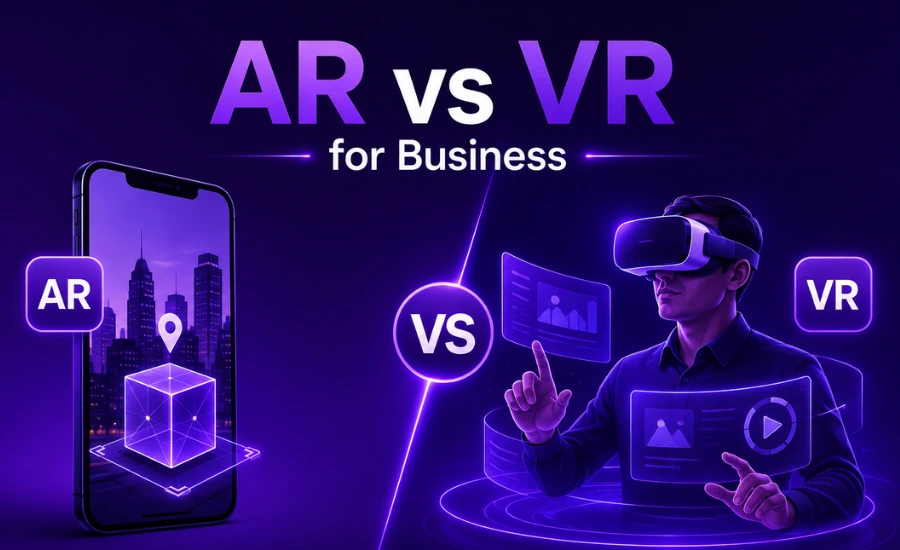
Augmented reality (AR) adds digital layers 3D models, information panels, navigation arrows on top of the real world. It runs on smartphones, tablets, and increasingly on lightweight AR glasses. Users stay fully aware of their physical surroundings, which is why AR is the technology behind furniture “place in your room” apps, warehouse pick-path overlays, and AR-powered marketing filters, as outlined in Microsoft’s guide to augmented reality.
Virtual reality (VR) replaces the real world entirely with a computer-generated environment, typically experienced through a headset like a Meta Quest or an enterprise-grade device such as the Varjo XR series. Because VR blocks out physical surroundings, it’s better suited to controlled, repeatable scenariosa surgeon rehearsing a procedure, a factory worker practicing an equipment shutdown sequence, or a real estate buyer walking through a property that hasn’t been built yet.
Neither technology is objectively “better.” The right choice depends on whether your use case needs the user to stay grounded in reality (AR) or benefits from full sensory replacement (VR).
How Do AR and VR Actually Work for Businesses? (Comparison Table)
For a deeper technical breakdown of how these overlays function, IBM’s explainer on augmented reality is a useful reference point.
| Factor | Augmented Reality (AR) | Virtual Reality (VR) |
|---|---|---|
| Hardware | Smartphone, tablet, AR glasses | VR headset (Quest, Vive, Varjo) |
| Environment | Real world + digital overlay | Fully simulated environment |
| Typical cost to deploy | $15,000–$50,000 for a pilot app | $30,000–$80,000+ (headsets + custom build) |
| Best for | Retail, field service, marketing, navigation | Training, simulation, design review, remote collaboration |
| Adoption barrier | Low most users already own a phone | Higher requires headset distribution |
| Data captured | Location, engagement, interaction heatmaps | Time-on-task, error rates, completion scores |
| GDPR/privacy note | Location and camera data require consent flows | Biometric and movement data need explicit handling under GDPR |
Which Industries Benefit Most from AR vs VR for Business?
AR performs best for:
- E-commerce and retail virtual try-on, “view in your space” product previews that reduce return rates
- Real estate AR overlays showing renovation potential or floor plan changes on-site
- Field service and manufacturing technicians see repair instructions overlaid on the actual machine
- Marketing agencies AR filters and interactive campaigns that boost social engagement
VR performs best for:
- Healthcare and education surgical simulations, clinical training without patient risk
- Construction walking stakeholders through a building before it’s built
- Manufacturing safety training in hazardous environments without real-world risk
- Enterprise collaboration distributed teams reviewing 3D product designs together in a shared virtual space
Businesses in competitive metros like San Francisco and Seattle tend to lean toward VR for enterprise training given the concentration of tech and manufacturing employers, while Miami, Dallas, and Houston businesses many in real estate, retail, and energy see faster wins from AR-based customer-facing tools.
How Much Does AR/VR App Development Cost for Businesses?
Costs vary widely based on scope:
Cost is one of the biggest factors in the AR vs VR for business decision, since VR typically requires more upfront investment in hardware and custom environments than AR does.
- Basic AR marketing app or product viewer: $10,000–$25,000
- Custom AR app with e-commerce integration: $25,000–$50,000
- VR training simulation (single scenario): $30,000–$60,000
- Enterprise VR platform with multiple modules and analytics: $60,000–$150,000+
The biggest cost drivers are custom 3D asset creation, backend integration (CRM, inventory, LMS), and whether the app needs to work across both iOS and Android or support multiple headset brands.
This is where the quality of your 3D visualization work directly affects your budget poorly modeled assets mean expensive revisions later. Howow Studio’s 3D visualization and animation team builds product and environment models specifically optimized for AR/VR performance from the start, which keeps rework costs down for clients scaling from pilot to full rollout.
Which Should Your Business Choose AR or VR?
Ask three questions before deciding:
- Does the use case need the user to stay aware of their physical surroundings? If yes, choose AR (field service, in-store retail, on-site real estate).
- Is the goal repeatable training or simulation in a controlled setting? If yes, choose VR (safety training, surgical practice, design walkthroughs).
- What’s your budget and rollout timeline? AR is typically faster and cheaper to pilot since it runs on existing smartphones; VR requires hardware investment but delivers deeper engagement for high-stakes training.
Many enterprises eventually run both AR for the customer-facing layer, VR for internal training but the right first move is a focused pilot with a clear KPI (return rate reduction, training completion time, lead conversion) rather than a broad “innovation” project with no measurable outcome.
What Are the Emerging AR/VR Business Trends in 2026?
According to Gartner’s Top Technology Trends for 2026, enterprise adoption of immersive technology is now outpacing consumer use cases.
- Mixed reality (MR) convergence devices that blend AR and VR modes are reducing the need to choose one platform permanently.
- AI-powered AR assistants real-time object recognition and voice-guided AR instructions are replacing static overlays.
- Enterprise adoption outpacing consumer training, design, and field service use cases are now the primary growth driver, not gaming.
- Lower-cost standalone headsets pricing has dropped enough that mid-sized businesses, not just Fortune 500 enterprises, are piloting VR training.
- Web-based AR (WebAR) no app download required, which is accelerating AR adoption in e-commerce specifically.
For companies across New York, Los Angeles, Chicago, Austin, and Boston, the practical starting point in 2026 is usually WebAR for customer-facing use cases it has the lowest friction and fastest measurable ROI.
FAQs
Is AR or VR better for small businesses? AR is generally the better starting point for small businesses. It requires no special hardware, works on smartphones customers already carry, and typically costs less to develop and deploy than a VR solution.
Can one company use both AR and VR? Yes. It’s common for a business to use AR for customer-facing tools (product visualization, marketing) and VR for internal use cases like staff training or design collaboration they serve different parts of the business.
How long does it take to build an AR or VR app? A focused AR pilot typically takes 8–14 weeks from scoping to launch. A custom VR training module usually takes 10–18 weeks, depending on the complexity of the 3D environments and whether analytics/reporting are included.
Does AR/VR development need to comply with GDPR for European customers? Yes. If your AR/VR app collects location data, camera input, or biometric/movement data from users in the EU or EEA, it falls under GDPR and requires explicit consent flows, clear data retention policies, and in many cases a data protection impact assessment before launch.
Ready to Bring AR or VR Into Your Business?
Choosing between AR and VR isn’t a guessing game it comes down to matching the technology to a specific, measurable business outcome. Whether that’s a product visualizer that cuts e-commerce returns or a VR training module that gets new hires productive faster, the execution matters as much as the decision.
Howow Studio has spent 15+ years building custom digital solutions from web development to 3D visualization and animation to custom app development for businesses across the US and Europe, backed by a 60+ person team and 5,000+ happy clients. If you’re weighing AR against VR for your next project, our team can scope a pilot that fits your budget and timeline instead of a generic build.
Looking to scale your business with a modern website, AR/VR pilot, or high-converting Local SEO? Book a free 15-minute strategy consultation with Howow Studio today or message us directly on WhatsApp.
Explore more on the Howow Studio blog or visit our homepage to see the full range of services.