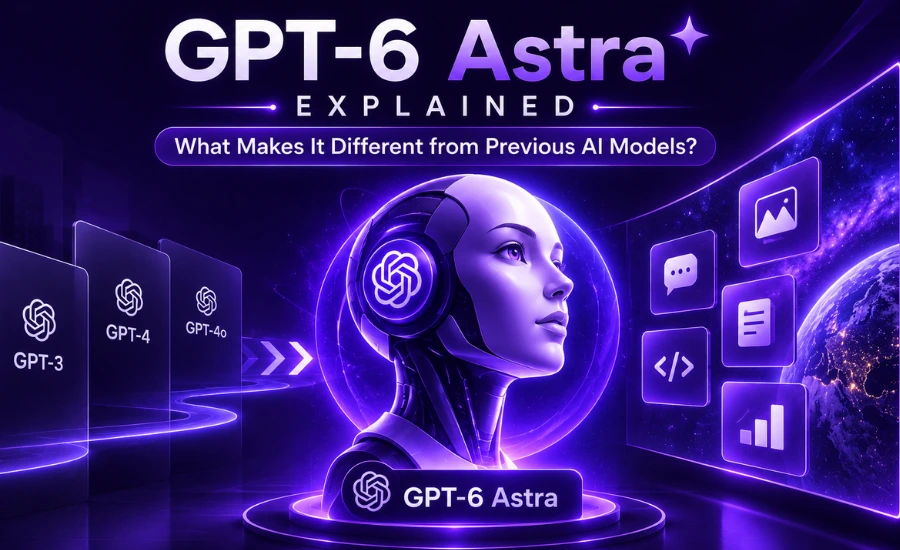
GPT-6 Astra Explained: What Makes It Different from Previous AI Models?
Quick answer: GPT‑6 Astra is OpenAI’s flagship model, released on September 3–4, 2026 as the successor to GPT‑5.6 Sol. It’s built around agentic work, not chat. It leads benchmarks in computer use, coding, cybersecurity, and science, and runs through ChatGPT, the OpenAI API, Microsoft Azure Foundry, and AWS Bedrock. For European businesses with US operations, the real shift is that Astra can operate software directly, including tools like Blender.
If you run a SaaS company, a digital agency, or an enterprise IT team with a US foothold, ‘which model should we build on’ isn’t a side question anymore. It decides how much engineering time you save. It also decides how defensible your product roadmap is. GPT‑6 Astra changes that calculation. Here’s what it actually is, how it compares to GPT‑5, and where it fits into a real business stack.
What Is GPT-6 Astra?
GPT‑6 Astra is OpenAI’s most capable model to date, positioned explicitly for professional and agentic work rather than general conversation. It rolled out to a limited set of organizations on September 3, 2026. General availability followed the next day across ChatGPT Plus, Pro, Business, and Enterprise plans. OpenAI calls it state-of-the-art on computer use, web browsing, software engineering, cybersecurity, and scientific reasoning. It’s a deliberate shift away from ‘smarter chatbot’ and toward ‘AI that operates your tools for you.”
Key technical facts:
- Predecessor: GPT‑5.6 Sol
- API model name:
gpt-6-astra - Context window: ~1.05 million tokens, with a 128,000-token maximum output
- Knowledge cutoff: April 30, 2026
- Availability: ChatGPT (Plus/Pro/Business/Enterprise), OpenAI API, Codex, Microsoft Azure Foundry, AWS Bedrock
How Is GPT-6 Astra Different from GPT-5?
The headline difference isn’t raw conversational quality it’s what the model can do once it understands a task. Astra is built to operate a computer the way a human employee would. It opens applications, clicks through interfaces, and writes and corrects its own code. It also carries a multi-step task through to completion without constant hand-holding.
| Capability | GPT-5.6 Sol | GPT-6 Astra |
|---|---|---|
| Computer/browser use (OSWorld 2.0) | Baseline | ~72.6%, roughly 47% less time per task |
| Math reasoning (FrontierMath Tier 4) | Lower | ~97–98% |
| Cybersecurity capability tier | Below Critical | First model to reach “Critical” under OpenAI’s Preparedness Framework |
| Misaligned-outcome rate in realistic work tasks | ~18.8% | ~3.4% |
| Context window | Smaller | ~1.05M tokens |
| Positioning | General assistant | Agentic, task-completion focused |
Key takeaways:
- Astra isn’t just a bigger language model. It’s tuned to stay on task and finish multi-step workflows with less supervision.
- Its cybersecurity capability is strong enough that OpenAI gates the most sensitive features. Only vetted organizations get full access.
- The context window increase means it can hold entire codebases, contracts, or research papers in a single session without losing earlier detail.
What Can GPT-6 Astra Actually Do for Businesses?
For operations, marketing, and engineering teams, the practical use cases fall into a few clear buckets:
- AI coding assistant Astra is positioned by OpenAI as its strongest software engineering model yet, with an updated Codex harness for agentic coding tasks.
- Computer use AI it can navigate a real desktop environment (browsers, forms, internal tools) to complete tasks like filing paperwork, running searches, or testing a website end-to-end.
- AI research assistant the larger context window lets it digest long reports, compare data sources, and produce structured findings in one pass.
- Agentic AI / AI automation through OpenAI’s Agents API, businesses can chain Astra’s reasoning with external tools to automate recurring workflows instead of scripting each step manually.
- Enterprise AI solutions with Zero Data Retention available for eligible API customers, it’s a more realistic option for companies with strict data-handling requirements.
This is where the gap between “using AI” and “building AI-powered products” becomes obvious. A model this capable is only as useful as the system wrapped around it the website, the workflow automation, the integration layer a customer actually touches. That’s the layer where a technical partner like Howow Studio typically comes in: turning an API capability into a working custom application or a production-ready website that a client’s team can actually use day to day.
How Much Does GPT-6 Astra Cost and How Do You Access It?
OpenAI prices Astra through its standard API at $10 per million input tokens and $50 per million output tokens, with cache reads at roughly $1 per million tokens and cache writes around $12.50 per million. A “Fast mode” runs up to twice as quickly at roughly double the standard price. Businesses can access it through:
- ChatGPT Plus, Pro, Business, or Enterprise subscriptions (usage included within existing plan allowances, with credits available for overflow)
- OpenAI API directly, using the
gpt-6-astramodel ID - Codex, OpenAI’s coding-focused product, for agentic software engineering work
- Microsoft Azure Foundry and AWS Bedrock, for teams standardized on those cloud platforms
For European companies billing in €, GBP, or NOK, API costs are typically settled in USD regardless of provider, so it’s worth building currency conversion and usage monitoring into your budgeting from day one rather than after the first invoice.
Is GPT-6 Astra Safe for GDPR-Sensitive European Businesses?
This is the question most compliance and legal teams will ask before anyone else touches the model. Two things matter here:
- Cybersecurity capability is gated. Astra is the first OpenAI model to cross the “Critical” threshold on OpenAI’s own Preparedness Framework for cyber capability. In practice, this means the publicly available model declines advanced offensive-security tasks (such as building proof-of-concept exploits), while more sensitive capabilities are restricted to vetted organizations through OpenAI’s trusted-access program.
- Data handling is more configurable. Zero Data Retention is available for eligible API customers, which matters for any business processing personal data under GDPR. As always, ZDR eligibility and the specific data processing terms should be confirmed directly with OpenAI (or your cloud provider, if accessing Astra through Azure or Bedrock) and reviewed against your own GDPR obligations before rollout this article isn’t a substitute for that review.
If your business already collects payments through Klarna, Vipps, or standard EU card processing, none of that changes because of the model but any AI feature that touches customer data still needs its own data processing agreement and privacy review, same as any other vendor.
Can GPT-6 Astra Build 3D Models in Blender?
Yes and this is one of the more unusual capabilities OpenAI highlighted at launch. Because Astra can operate a computer’s interface directly (not just generate code), it can open Blender, interpret a reference image or written brief, and build matching 3D geometry inside the application itself.
How Does an Astra-to-Blender Workflow Actually Work?
There isn’t a single official “Astra Blender plugin” instead, the model reaches Blender through one of two paths:
- Computer use, where Astra views the Blender interface (through screenshots) and operates it directly clicking tools, adjusting parameters, and checking its own results visually.
- Scripted control, where Astra writes Python code against Blender’s
bpyAPI to build or modify a scene programmatically, which is generally faster and more repeatable for production work.
A typical pipeline looks like this: generate concept art, model the matching geometry in Blender, apply materials and lighting, then hand the finished asset to a game engine like Unreal Engine 5 or Unity for final assembly with Astra carrying the task through each stage rather than a person manually exporting and re-importing files between tools.
For product visualization, architectural walkthroughs, or game asset pipelines, this is a genuine shift: less manual modeling time, faster first drafts, more iteration cycles per day. It’s also exactly the kind of workflow where an AI-generated first pass still benefits from a human eye for composition, brand consistency, and render quality which is where a dedicated 3D visualization and animation team adds value on top of what the model produces on its own.
Why Should European Businesses Operating in the US Care About GPT-6 Astra?
European companies expanding into US markets whether you’re a Berlin-based SaaS team opening a New York office, an Irish agency pitching clients in Austin, or a Nordic manufacturer building a Houston distribution presence are competing against US-based teams that will adopt frontier models fast. Astra’s availability through Azure and AWS Bedrock (both already common in enterprise US IT stacks, and used by many EU companies for data residency reasons) makes it straightforward to deploy without standing up new infrastructure from scratch.
The practical takeaway: the competitive gap won’t come from which company “has AI” it’ll come from which company has AI wired into a fast, well-built website, a working automation layer, and a support process a customer actually experiences. That’s an execution problem, not a model-selection problem.
FAQs
Is GPT-6 Astra the same as GPT-5? No. Astra is a new, separate flagship model succeeding GPT‑5.6 Sol, with different pricing, a larger context window, and a stronger focus on computer use and agentic tasks.
Can I use GPT-6 Astra through the API without a ChatGPT subscription? Yes. It’s available as gpt-6-astra through the standard OpenAI API, independent of a ChatGPT plan, as well as through Microsoft Azure and AWS Bedrock.
Does GPT-6 Astra work with 3D software besides Blender? OpenAI’s public demonstrations center on Blender combined with game engines like Unreal Engine 5, using the same computer-use and scripting capabilities that could, in principle, extend to other desktop 3D or CAD tools.
Is GPT-6 Astra suitable for GDPR-regulated European companies? It can be, provided you confirm Zero Data Retention eligibility and review the data processing terms for your specific access route (direct API, Azure, or Bedrock) that verification should happen before any customer data touches the model.
Ready to Turn AI Capability Into a Working Product?
Looking to scale your European business with a modern website or high-converting Local SEO? Book a free 15-minute strategy consultation with Howow Studio today.
Explore more insights on our blog, or head back to Howow Studio’s homepage to see our full range of services.