RAG AI Explained: How Businesses Can Use Their Own Data with AI
Quick Answer: RAG AI (Retrieval-Augmented Generation) is an AI architecture that connects a language model to a business’s own documents, databases, and knowledge bases, so it answers questions using real, current company data instead of guessing from generic training data. It solves the two biggest problems businesses have with generic AI outdated knowledge and “hallucinated” answers without the cost of training a custom model from scratch. Most companies can deploy a working RAG AI chatbot in weeks, not months, and keep full control over where their data lives.
Generic AI chatbots are confident, fluent, and frequently wrong about anything specific to your company which is exactly the gap RAG AI was built to close. Ask ChatGPT about your refund policy, your product specs, or your client contracts, and it either says “I don’t know” or worse makes something up. For a law firm, a healthcare provider, or a SaaS company handling customer data, that’s not a minor inconvenience. It’s a liability.
RAG AI exists to fix exactly this. It’s the architecture behind most serious enterprise AI deployments in 2026, and it’s the reason a growing number of US businesses from Austin startups to New York financial firms are finally getting AI systems that actually know their business.
What Is RAG AI and How Does It Work?
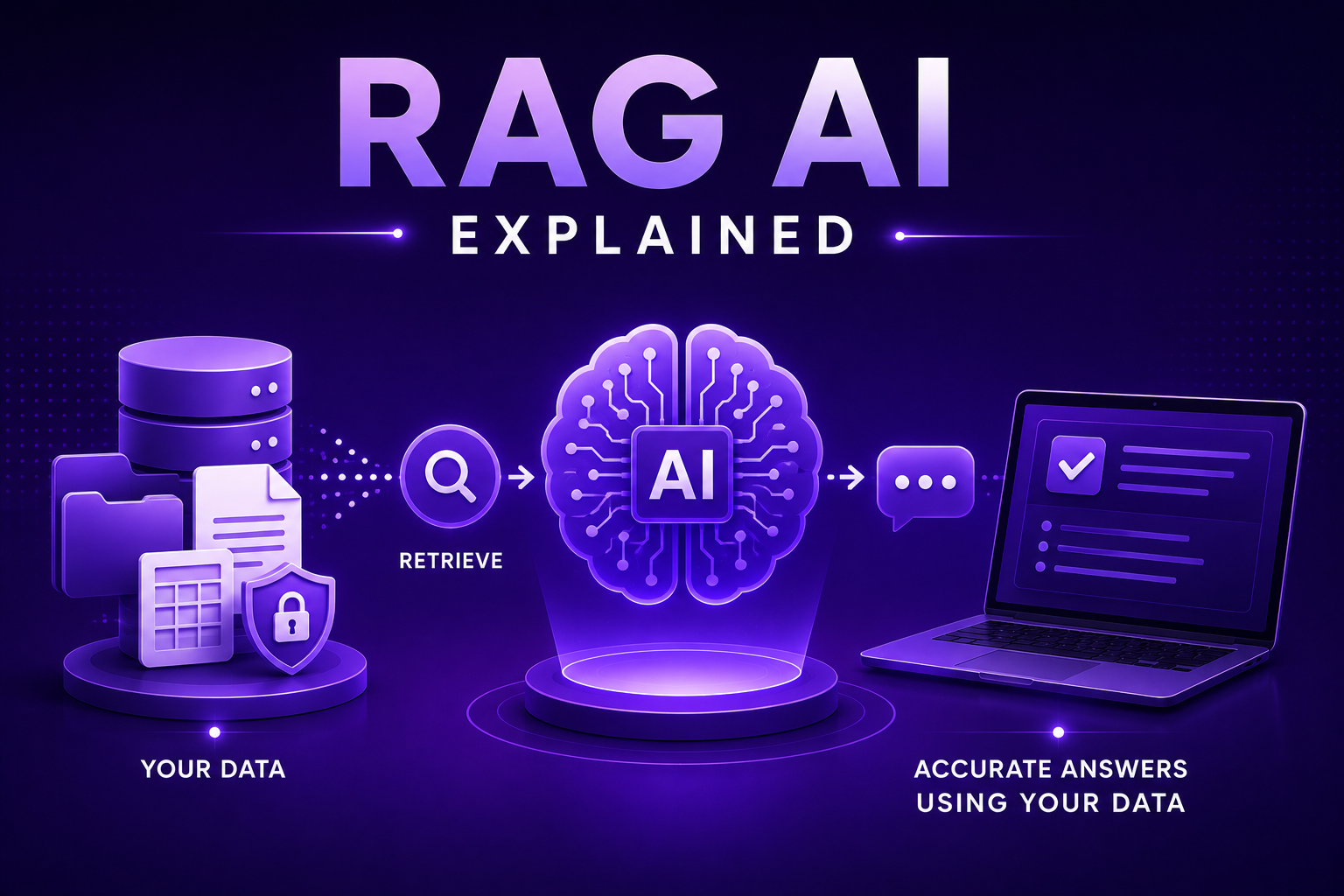
Retrieval-Augmented Generation combines two systems: a retrieval engine that searches your company’s documents, and a generative AI model that writes the answer. When a user asks a question, the system first searches a private knowledge base contracts, product manuals, support tickets, CRM records, internal wikis for the most relevant pieces of information. It then feeds those retrieved snippets to the language model along with the original question, and the model generates a response grounded in that specific data.
This is fundamentally different from just “using ChatGPT.” A standard large language model only knows what it was trained on, frozen at some point in the past, and has no access to your private files at all. RAG changes that by having the model check an authoritative, outside knowledge base before it answers a concept explained in more depth in IBM’s overview of Retrieval-Augmented Generation. That single design choice is what makes RAG AI usable in a business setting the answers are traceable back to a real source document, not invented.
Core components of a RAG AI system:
- Document ingestion – Company files (PDFs, spreadsheets, help-center articles, CRM entries) The system break into chunks and converts them into searchable vector embeddings.
- Vector database – Stores those embeddings so the system can find semantically relevant content in milliseconds.
- Retriever – Pulls the most relevant chunks for a given question.
- Generator (LLM) – Writes a natural-language answer using the retrieved context.
- Access controls – Restricts which users or roles can see which documents, critical for law firms, healthcare, and financial companies.
Why Should Businesses Use RAG AI Instead of a Generic Chatbot?
A generic chatbot is a closed box. A RAG AI chatbot is an open, updatable system built around your actual operations. The practical differences show up fast:
- Accuracy on company-specific questions answers come from your documents, not the model’s guesswork.
- Always current update the knowledge base and the AI’s answers update immediately; no retraining required.
- Lower cost than fine-tuning you’re not paying to train a custom model, just to index and query your data.
- Full data control your documents can stay inside your own infrastructure or a private cloud environment, which matters enormously for GDPR-conscious European founders now operating in the US market, as well as for HIPAA and CCPA compliance domestically.
- Source transparency most RAG systems can cite exactly which document an answer came from, which is essential for legal, financial, and healthcare use cases.
How Does It Compare to Fine-Tuning and Generic AI Chatbots?
| Factor | RAG AI | Fine-Tuned Model | Generic AI Chatbot |
|---|---|---|---|
| Uses your company data | Yes, in real time | Yes, but “baked in” at training time | No |
| Setup cost | Moderate | High | Low (but limited value) |
| Time to deploy | Days to a few weeks | Weeks to months | Immediate |
| Keeping data current | Update the knowledge base anytime | Requires retraining | Not applicable |
| Data security & access control | High data can stay private | Depends on training pipeline | Low no company data used |
| Best for | Customer support, internal knowledge search, document Q&A | Highly specialized tone/behavior at scale | General, non-business-specific tasks |
| Risk of hallucination | Low, the system grounds answers in retrieved sources | Moderate | High |
For most mid-sized businesses, RAG AI is the practical middle ground: far more useful than a generic chatbot, far cheaper and faster than fine-tuning a proprietary model.
How Much Does RAG AI Implementation Cost for a Business?
Costs vary by data volume, integration complexity, and whether you need custom access controls, but three cost drivers show up in almost every project:
- Data preparation cleaning, structuring, and indexing existing documents (often the largest line item for businesses with years of unorganized files).
- Infrastructure vector database hosting, API usage for the underlying model, and storage.
- Integration connecting the RAG system to your website, CRM, support desk, or internal tools.
A focused, single-use-case deployment (say, a customer support chatbot trained on a help center) is typically far more affordable than an enterprise-wide knowledge assistant spanning legal, HR, and sales data. Businesses evaluating RAG AI solutions USA-wide should request a scoped pilot first a two- to four-week proof of concept on one department’s data before committing to a company-wide rollout.
Is RAG AI Secure for Confidential Business Data?
This is the question every CTO, law firm partner, and healthcare compliance officer asks first, and it’s the right one. Security depends entirely on how you architect the system, not on RAG as a concept. Because a well-designed RAG setup pulls current information at query time instead of baking it permanently into a retrained model, businesses actually get more control over where sensitive data lives as AWS’s explainer on Retrieval-Augmented Generation and Google Cloud’s RAG use-case overview both note in describing the architecture’s data-handling advantages.
Practical safeguards businesses should insist on:
- Private or self-hosted vector databases rather than shared public endpoints
- Role-based access control so employees only retrieve data they’re authorized to see
- Encryption at rest and in transit
- Clear data residency know exactly which region which region stores and processes your data
- Audit logs showing who retrieved what, and when
For European-founded businesses operating in the US, this matters twice over: you’re often balancing GDPR-level expectations around consent and data minimization with US regulatory frameworks like HIPAA or state privacy laws — and a properly scoped RAG system, unlike a public chatbot, can be built to satisfy both.
Which US Industries Benefit Most from RAG AI?
- Law firms instant, cited answers pulled from case files and contracts instead of manual document review.
- Healthcare organizations clinical staff and patients get accurate answers from approved medical documentation, not open-web guesses.
- Financial companies compliance-safe answers grounded in internal policy documents and regulatory filings.
- Real estate companies property details, listings, and contract terms answered instantly for buyers and agents.
- E-commerce brands AI-powered customer support that actually knows your return policy, shipping rules, and product catalog.
- SaaS companies an AI knowledge base that reduces support ticket volume by answering from your own documentation.
This is also where a strong website and support infrastructure matter as much as the AI itself a RAG chatbot is only as good as the platform it’s embedded in. Teams building or upgrading their site alongside an AI rollout often lean on partners who can handle both; this is one of the areas where Howow Studio’s web development expertise pairs naturally with AI integration work, since a fast, well-structured website gives a RAG chatbot a reliable place to actually live.
How Can Businesses Across the US Get Started?
Demand for enterprise AI solutions USA-wide is concentrated in tech and business hubs, but the implementation playbook is the same everywhere:
- RAG AI New York and RAG AI Los Angeles financial services, media, and entertainment companies using RAG for internal knowledge search and client-facing support.
- RAG AI Chicago, Houston, and Dallas logistics, manufacturing, and energy firms using RAG to search technical documentation and compliance records.
- RAG AI Miami and San Francisco fast-growing SaaS and e-commerce companies using RAG-powered support to scale without scaling headcount.
- RAG AI Seattle, Boston, and Austin tech-forward businesses integrating RAG into existing product stacks and internal tools.
Wherever your business is based, the starting point is the same: a clear inventory of what data you actually have, and one well-defined use case to pilot first.
What Does the RAG AI Implementation Process Look Like?
- Audit your data identify which documents, systems, and databases the AI should draw from.
- Clean and structure the data remove duplicates, outdated files, and inconsistent formatting.
- Choose a retrieval and hosting setup private cloud, hybrid, or fully self-hosted, depending on your compliance needs.
- Build and test the chatbot or search interface starting with one use case, such as customer support or internal document search.
- Deploy with access controls in place role-based permissions from day one, instead of adding them later.
- Monitor and refine track which questions the AI struggles with and expand the knowledge base accordingly.
Businesses that get this right treat RAG AI as infrastructure, not a novelty feature and infrastructure needs to be planned alongside the rest of the business’s digital presence. Companies exploring business AI automation for the first time often benefit from pairing it with a broader digital audit; it’s a step our team frequently walks clients through as part of Howow Studio’s custom app development process, aligning the AI layer with the systems it needs to talk to.
Frequently Asked Questions
Is RAG AI the same as ChatGPT? No. ChatGPT and similar tools are general-purpose language models. RAG AI is an architecture that connects a language model like that to your own private data, so answers reflect your business, not just general internet knowledge.
Does RAG AI require training a custom model? No. That’s the core advantage RAG retrieves relevant data at the moment of the question instead of requiring you to retrain the model itself, which keeps costs and deployment time significantly lower.
Can RAG AI work with PDFs, spreadsheets, and CRM data at the same time? Yes. A properly built RAG system can ingest multiple document types and structured data sources, indexing all of them into a single searchable knowledge base.
Is RAG AI GDPR-compliant? RAG AI itself is just an architecture compliance depends on how you implement it. Private hosting, data minimization, and clear access controls are what make a RAG deployment GDPR- or HIPAA-compliant, not the technology by default.
Ready to Put Your Business Data to Work?
Looking to scale your business with a modern website, a custom AI chatbot, or high-converting Local SEO? Book a free 15-minute strategy consultation with Howow Studio today.
Explore more insights like this on the Howow Studio blog.